

What Is Fractional Gold? Sizes, Formats, Premiums and Examples
Quick answer. Fractional gold is any piece of gold sold below one troy ounce (31.1035 grams) as a coin, bar, round or polymer-encased piece, in sizes down to single-digit milligrams. The smaller the piece, the more it costs per ounce. Conventional fractional bullion prioritizes metal value, while formats such as Goldback trade a higher premium for smaller denominations, built-in verification and direct-transfer utility.
| Definition | Gold sold in units smaller than one troy ounce (31.1035 grams) |
|---|---|
| Smallest common size | One gram among widely available pieces; production reaches about eight milligrams |
| Four physical formats | Coins · bars · rounds · polymer-encased gold |
| Why people buy it | Smaller outlay per piece, divisibility, portability and, in some formats, direct transfer |
| Main trade-off | The smaller the piece, the higher the premium per ounce of gold inside it |
The term gets used loosely. Dealers apply it to a shelf of small coins; news coverage applies it to apps that sell gold by the dollar. Neither covers the full range of what is actually produced.
What fractional gold means
Fractional gold is gold sold in units smaller than one troy ounce. The term covers several physical formats — coins, bars, rounds and polymer-encased gold — in sizes ranging from half an ounce down to a few milligrams.
A troy ounce is 31.1035 grams, the standard unit for pricing gold. Anything below it, sold as a discrete piece of stated weight and fineness, is fractional gold.
Why “less than one troy ounce” is an incomplete definition
Most published definitions stop at the weight threshold, then illustrate it with three coin sizes: 1/2, 1/4 and 1/10 of an ounce. That describes a shelf, not a category.
Weight alone does not determine how small a piece of gold can practically be. Format does. A struck coin, a poured bar and a sheet of gold bonded between polymer layers face different physical limits, and those limits sit orders of magnitude apart, which is why one format stops near a gram and another reaches a few milligrams.
The four formats fractional gold comes in
Fractional gold takes four physical forms: sovereign and private coins, minted or cast bars, private rounds, and polymer-encased gold in which a thin gold layer is bonded between polymer sheets. Format determines the smallest practical size far more than weight alone.
| Format | Smallest practical size | Main advantage | Typical use |
|---|---|---|---|
| Coins | 1/25 oz (1.24 g) | Sovereign guarantee of weight and purity | Recognized, widely traded holdings |
| Bars | 1 grain (64.8 mg) | Priced on weight, with low production overhead | Small-outlay bullion ownership |
| Rounds | Sold by weight, with no separate tier in the ladder below | Refiner-priced alternative to coins | Weight-based holdings without a sovereign premium |
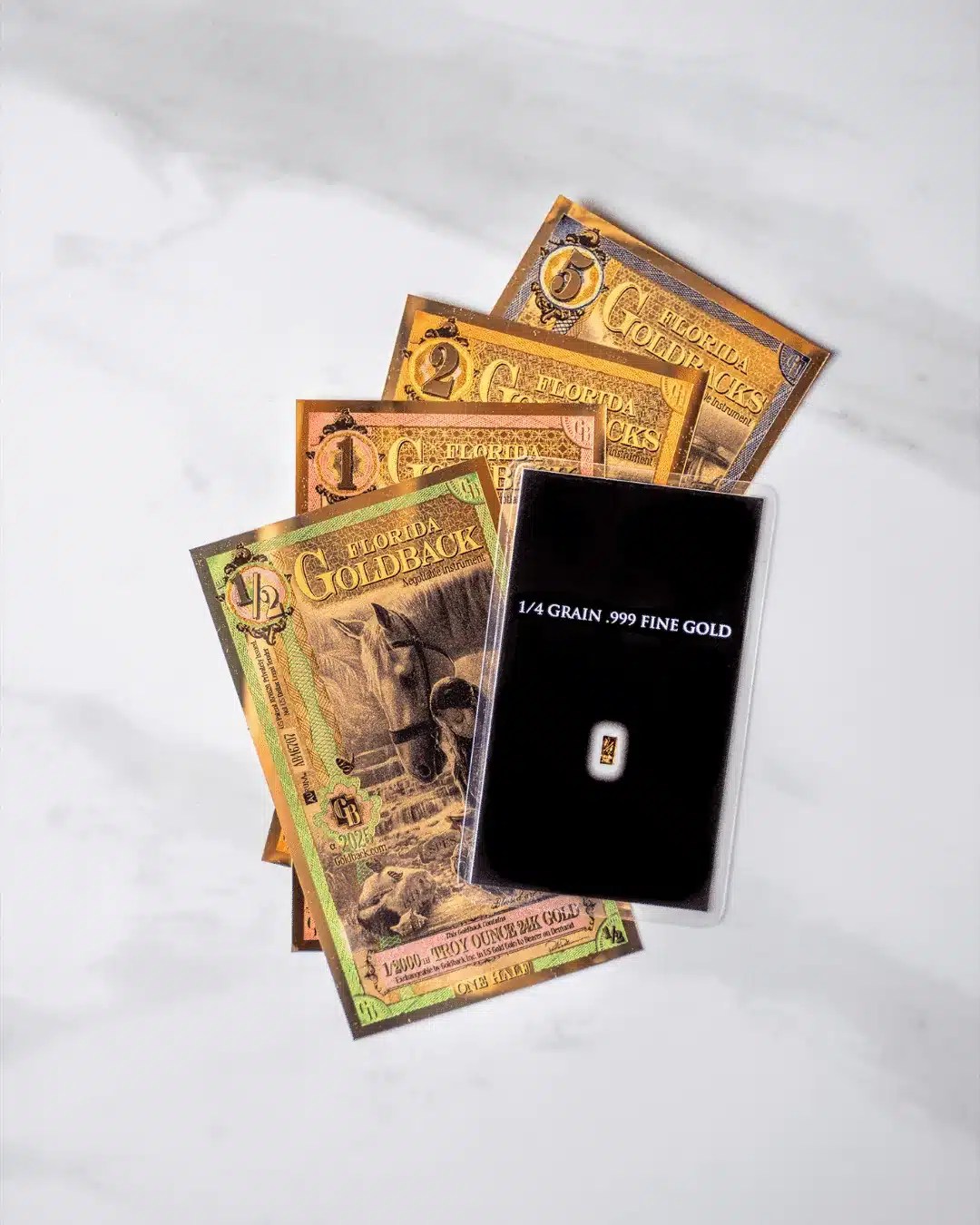
| Polymer-encased gold | 1/4 Goldback (7.78 mg) | Reaches the smallest tiers, with verification built into the piece | Very small denominations and direct transfer |
Coins are struck by government mints and carry a face value, a sovereign guarantee of weight and purity, and checkable dimensions. The American Gold Eagle comes in four sizes: one ounce, 1/2, 1/4 and 1/10 ounce, the smallest measuring 16.5 mm across, roughly the size of a dime. The Canadian Gold Maple Leaf adds a 1/20 ounce coin at 14.1 mm; the Austrian Gold Philharmonic reaches 1/25 ounce at 13 mm, the smallest coin in that series.
Bars are minted or cast by private refiners and sold by weight rather than face value. One-gram bars are the common small size; the Valcambi CombiBar is a sheet of one-gram sections that snap apart individually. Smaller wafers exist down to half a gram.
Rounds are coin-shaped but struck privately, with no face value and no sovereign guarantee. They are priced on weight and the refiner’s reputation.
Polymer-encased gold bonds a thin layer of gold between polymer sheets in a flat, flexible rectangle, deposited across the surface rather than formed into a solid piece. Valaurum has produced the format since it was founded in 2012, using a patent-protected vacuum-deposition process; it makes Aurum Precision Notes and also produces Goldbacks, a hyper-fractional 24K gold currency designed to be spent. See how polymer-encased gold is made and used for the mechanics.
Is polymer-encased gold really bullion?
Some bullion dealers say it is not. “Bullion” conventionally describes gold traded close to its melt value in recognized weights and forms. Polymer-encased gold contains gold of a stated weight and fineness, but it is neither sold nor typically resold near melt value. By that convention, it sits outside bullion. That distinction is not necessarily a disadvantage. Bullion is designed to track metal value efficiently; polymer-encased gold is designed to divide physical gold into smaller, portable and verifiable units.
It is still fractional gold. The two terms measure different things: fractional gold describes gold content below one troy ounce, while bullion describes a trading convention. Aurum notes and Goldbacks meet the first and not the second, and how polymer-encased gold differs from fractional bullion works through the distinction.
Every size fractional gold is made in
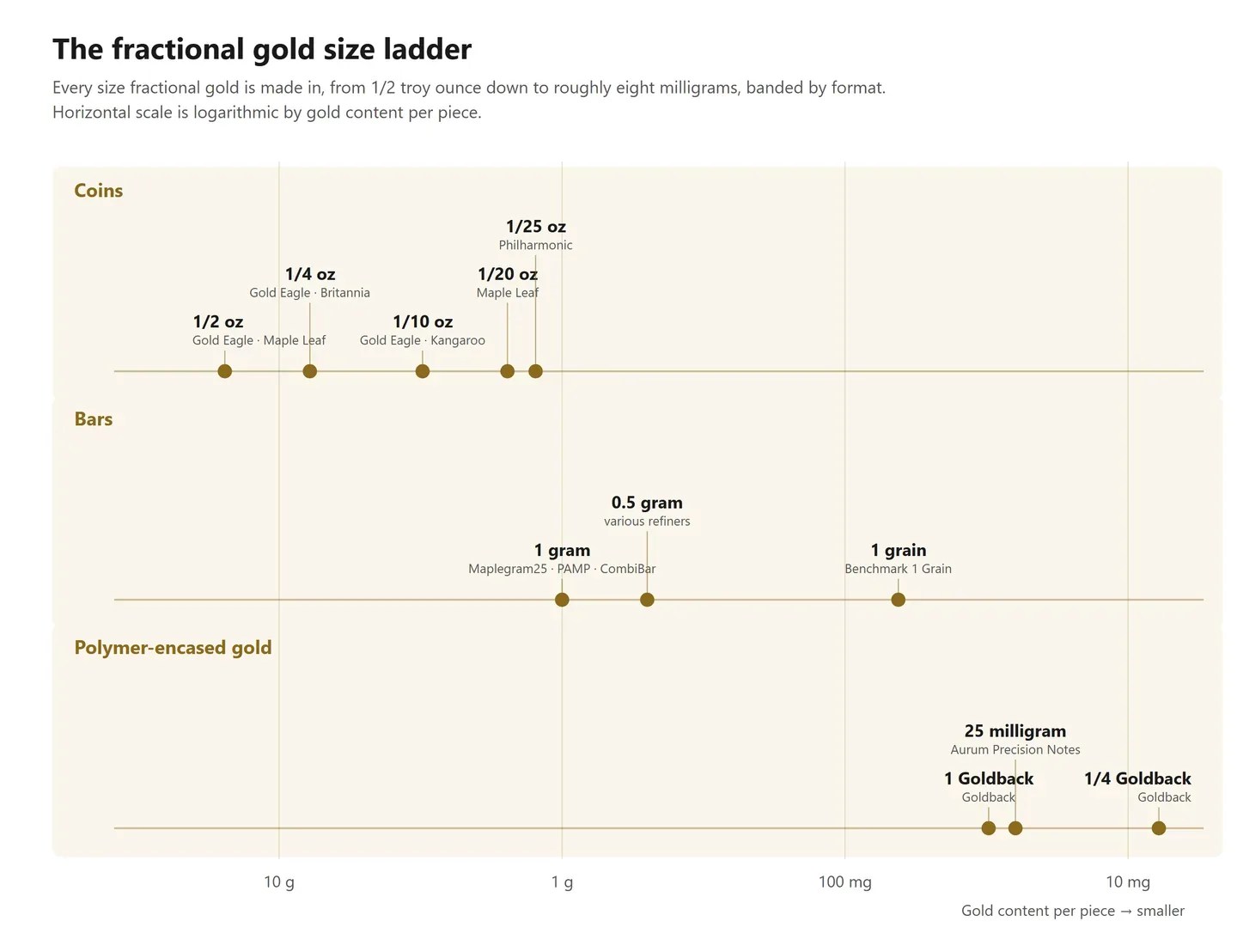
Fractional gold is produced from 1/2 troy ounce down to roughly eight milligrams. Common sizes are 1/2, 1/4 and 1/10 ounce coins and one-gram bars; less common tiers include 1/20 and 1/25 ounce coins, one-grain bars, and polymer-encased pieces measured in milligrams, or thousandths of an ounce.
The chart and table below show how the smallest practical size changes with format, not just with weight.
| Size as sold | Troy-ounce fraction | Gold content | Format class | Example | Availability |
|---|---|---|---|---|---|
| 1/2 oz | 1/2 | 15.55 g | Coin | American Gold Eagle, Gold Maple Leaf | Common |
| 1/4 oz | 1/4 | 7.78 g | Coin | American Gold Eagle, Britannia | Common |
| 1/10 oz | 1/10 | 3.11 g | Coin | American Gold Eagle, Gold Kangaroo | Common |
| 1/20 oz | 1/20 | 1.56 g | Coin | Canadian Gold Maple Leaf | Less common |
| 1/25 oz | 1/25 | 1.24 g | Coin | Austrian Gold Philharmonic | Less common |
| 1 gram | ~1/31 | 1.00 g | Coin / minted bar | RCM Maplegram25, PAMP Suisse, Valcambi CombiBar section | Common |
| 0.5 gram | ~1/62 | 0.50 g | Minted bar / wafer | Various refiners | Less common |
| 1 grain | 1/480 | 64.8 mg | Minted bar | Benchmark 1 Grain | Specialist |
| 1 Goldback | 1/1,000 | 31.1 mg | Polymer-encased | Goldback | Specialist |
| 25 milligram | ~1/1,244 | 25 mg | Polymer-encased | Aurum Precision Notes | Specialist |
| 1/4 Goldback | 1/4,000 | 7.78 mg | Polymer-encased | Goldback | Specialist |
Two things follow. The coin range runs further than most guides suggest, with three sizes below 1/10 ounce in regular production, and the bottom of the ladder is not a coin at all but bars measured in grains and polymer-encased gold measured in milligrams.
The smallest piece in the table holds exactly one four-hundredth of the gold in a 1/10 ounce coin, the size most published guides treat as the floor. Denomination and mintage records for those tiers are in the Goldback Safe.
Why premiums rise as pieces get smaller
Premiums rise as fractional gold gets smaller because minting, packaging, authentication and distribution cost roughly the same per piece regardless of gold content. A fixed cost spread across less metal produces a larger percentage premium at every step down in size.
The chart below shows the mechanism in one picture: a near-flat cost per piece against a shrinking amount of metal.
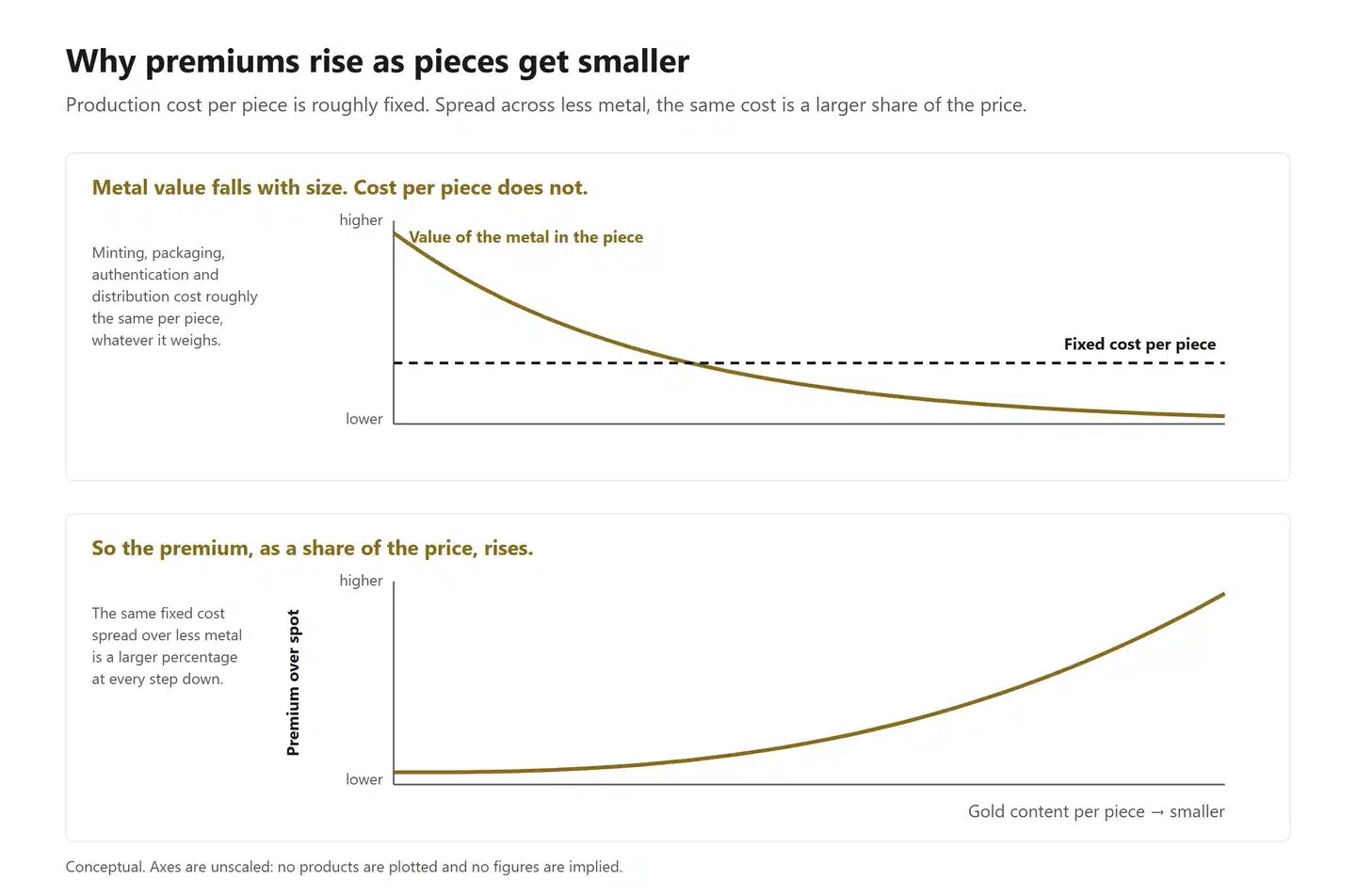
The shape is what matters: premium climbs at every step down in size, whatever the maker.
Striking a 1/20 ounce coin takes a die, a press, a quality check and a package, just as a one-ounce coin does. Sealing a one-gram bar in an assay card costs the same whether the card holds one gram or ten.
The published figures follow that curve. Provident Metals puts the markup on fractional gold coins at 9 to 15 percent relative to one-ounce coins. Across a wider set of formats, published premiums across eleven fractional gold options recorded in April 2026 ranged as follows:
- Roughly 8 to 15 percent — a one-gram CombiBar section
- Around 16 to 34 percent — 1/10 ounce sovereign coins
- Roughly 30 to 40 percent — a one-gram minted bar
- About 32 percent — a one-gram polymer-encased piece
- About 100 percent — the smallest tiers, a figure reached by both a one-grain bullion bar and a Goldback
Pricing data was checked in April 2026; premiums change with spot prices, supply, dealer spreads and availability.
The premium also buys different things depending on the format. Goldback is designed to provide utility beyond melt value: buyers who actively use them can get value from direct transfer, divisibility and verification features built into the piece itself. Whether that additional utility justifies the premium depends on the buyer’s intended use.
For buyers focused on the lowest premium over spot, conventional bullion may be the better fit. For buyers who value very small denominations and direct physical transfer, Goldback may offer greater practical utility.
Format alone does not set the premium: two polymer-encased products sit at opposite ends of that range, a one-gram piece near 32 percent and a 31-milligram piece near 100 percent, because they differ in size rather than in kind. Size is the largest single driver, but not the only one. Brand and demand, supply and availability, packaging, security features, and the costs of manufacturing and distribution all feed into what a piece sells for, so two pieces of the same weight can carry different premiums.
Where the range ends, and why
Fractional gold does not stop at 1/10 ounce — smaller coins and sub-gram formats exist. What changes below roughly one gram is the economics: the premium can approach or exceed the value of the metal, so pieces at that scale are generally made and bought for reasons beyond metal content.
The Maple Leaf reaches 1/20 ounce, the Philharmonic 1/25, and the Royal Canadian Mint makes one-gram Maplegram pieces. One-grain bars, Aurum notes and Goldbacks go further still.
Below about a gram the premium becomes a substantial share of the price, near 100 percent at the smallest tiers, or roughly twice the metal’s value. The piece is then bought for what the metal alone does not provide: divisibility, collectibility, security features, or direct transfer. That applies equally to a one-grain bullion bar, an Aurum note and a Goldback.
The boundary is economic, not physical. Gold can be made smaller than a milligram; the limit is where the cost of making, securing and distributing a piece outweighs what a buyer will pay for the gold in it. Gold bought to be used as money rather than held as metal is a different discussion, and what a gold-backed currency is covers it.
How fractional gold is verified
Verification methods differ by format: bars commonly ship in tamper-evident assay cards, coins rely on recognized mint specifications and dimensions, and polymer-encased gold carries embedded features such as serial numbers and reactive inks. Smaller pieces depend more on packaging and embedded features than on weight testing.
- Coins are verified against published mint specifications. A 1/20 ounce Gold Maple Leaf measures 14.1 mm across and 0.92 mm thick at .9999 fineness; a piece that misses those dimensions is not what it claims.
- Small bars and gram pieces are usually sealed in tamper-evident assay cards carrying a serial number. The Maplegram25 and the Benchmark one-grain bar both ship this way, the latter with a hologram seal. The packaging is part of the product; breaking it reduces resale value.
- Rounds carry no sovereign guarantee, so verification rests on the refiner’s hallmark and reputation.
- Polymer-encased gold carries features built into the piece rather than around it: serial numbers, reactive inks, crystallization patterns and raised imagery. Goldback publishes the verification features for its own pieces, checkable without unwrapping anything.
A one-ounce coin can be checked by weight and dimension with simple tools; a 25-milligram piece cannot be meaningfully weighed on a kitchen scale.
What fractional gold is not
Fractional gold means physically smaller pieces of gold held by the owner. Fractional ownership means a claim on gold stored elsewhere, sold by the gram or dollar through a platform. Gold-plated and gold-filled items are neither, because they contain negligible recoverable gold.
Fractional gold versus fractional ownership
Platforms such as OneGold, Vaulted and BullionVault sell fractional ownership: a buyer holds a claim on gold in a vault rather than the metal. Premiums are far lower, typically one to two percent, because nothing is minted, packaged or shipped. It is a genuine way to own gold in small amounts, but it is not fractional gold in the physical sense, and the distinction matters the moment someone wants the metal in hand.
Gold-plated, gold-filled and gold-clad items
These carry a surface layer of gold over base metal. The recoverable gold content is negligible; the value comes from the object, not the metal. “Gold-clad” commemoratives fall into this group.
“Gold-backed” digital tokens
Tokenized products represent a claim on gold reserves recorded on a ledger. Like fractional ownership, the same test applies: nothing changes hands as metal.
Which fractional-gold format fits which goal?
No single format serves every purpose. The best option depends on the intended use.
| Goal | Formats that fit | Why |
|---|---|---|
| Lowest premium over spot | 1/2 and 1/4 ounce coins, one-gram and larger bars | The fixed cost per piece is spread over more metal, so less of the price is production |
| Small physical ownership | 1/10 ounce sovereign coins, one-gram minted bars | Widely recognized and traded, at a moderate premium |
| Very small denominations | Polymer-encased gold, including Aurum Precision Notes and Goldback | Reaches milligram tiers that no coin or bar is produced in |
| Direct physical transfer | Goldback | Made to be handed from one person to another as a unit, without being sold or converted first |
| Collectibility | Sovereign fractional coins, Aurum Precision Notes | Dated series, published mintages and changing designs |
Key takeaways
- Fractional gold is any piece of gold sold below one troy ounce, or 31.1035 grams.
- It comes in four formats: coins, bars, rounds and polymer-encased gold.
- Sizes run from 1/2 troy ounce down to roughly eight milligrams.
- Coins reach 1/25 ounce; the smallest pieces are bars and polymer-encased gold.
- Premiums rise as pieces shrink, because production costs are roughly fixed per piece.
- Below about one gram, premium can approach or exceed the metal’s value.
- Fractional ownership is a claim on stored gold, not fractional gold.
- Goldback is fractional physical gold designed for very small denominations and direct transfer rather than for tracking melt value as closely as conventional bullion.
Frequently asked questions
What is fractional gold?
Fractional gold is gold sold in units smaller than one troy ounce, which is 31.1035 grams. It is produced as coins, bars, rounds and polymer-encased gold, in sizes from half an ounce down to a few milligrams.
What sizes does fractional gold come in?
Common sizes are 1/2, 1/4 and 1/10 troy ounce coins and one-gram bars. Less common tiers include 1/20 and 1/25 ounce coins, half-gram wafers, one-grain bars, and polymer-encased pieces measured in milligrams.
What is the smallest amount of gold you can buy?
The smallest widely available pieces are measured in milligrams rather than ounces. Polymer-encased gold reaches down to about eight milligrams, and specialist bullion bars are made in fractions of a grain at a similar scale. Among sovereign mints, one-gram pieces are the smallest in regular production.
Why is fractional gold more expensive per ounce than a one-ounce coin?
Minting, packaging, authentication and distribution cost roughly the same per piece regardless of gold content. Spread across less metal, those fixed costs represent a larger share of the price, so the premium over the gold’s value rises at every step down in size.
Is fractional gold real gold?
Yes. Fractional coins, bars, rounds and polymer-encased gold all contain gold of a stated weight and fineness. Gold-plated and gold-filled items are different: they carry a surface layer over base metal and hold negligible recoverable gold.
What is the difference between fractional gold and fractional gold ownership?
Fractional gold is physical metal the owner holds. Fractional ownership is a claim on gold stored in a vault, bought by the gram or dollar through a platform. Ownership platforms charge much lower premiums because nothing is minted, packaged or shipped.
How do you verify small pieces of gold?
Coins are checked against published mint specifications for weight, diameter and thickness. Small bars usually ship sealed in tamper-evident assay cards with serial numbers. Polymer-encased gold carries embedded features such as serial numbers and reactive inks that can be checked directly.
Does fractional gold include gold you can spend?
Some formats are, and they work differently. A Goldback is physical gold handed directly to the other party. Glint Pay is an account linked to gold holdings, spent by card, with the gold sold at the point of sale rather than transferred. Coins, bars and rounds must be sold or exchanged first. More in the Goldback FAQ.
Where to go next
For a side-by-side look at eleven fractional gold options on size, premium and usability, see our test of eleven ways to hold and spend fractional gold.
Goldback publishes this educational guide and issues one of the fractional-gold products discussed.
Related articles
- We Tested 11 Ways to Hold and Spend Fractional Gold
- Goldbacks vs. Fractional Bullion: What Sets Them Apart
- What Is a Gold-Backed Currency? A Complete Guide
Sources
- United States Mint — American Eagle gold bullion coin program; four sizes, 1/10 oz at 16.5 mm
- Royal Canadian Mint — Gold Maple Leaf 1/20 oz (14.1 mm × 0.92 mm, .9999); Maplegram25 one-gram pieces in serialized assay cards
- Austrian Mint — Gold Philharmonic 1/25 oz at 13 mm, introduced 2014
- The Royal Mint — Gold Britannia fractional sizes (1/2, 1/4, 1/10 oz, .9999)
- The Perth Mint — Australian Gold Kangaroo fractional sizes including 1/10 oz (.9999)
- World Gold Council — troy ounce definition and gold market reference
- LBMA — refining and fineness standards
- Valaurum — polymer-encased gold process, vacuum deposition, and patent-protected technology
- Benchmark Strategic Metals — one-grain bar specification and hologram-sealed certificate card
- Provident Metals — fractional gold coin premium range (coin-specific)
Related Articles
What Is Fractional Gold? Sizes, Formats, Premiums and Examples
Quick answer. Fractional gold is any piece of …

Goldback Podcast Ep. 4 Recap: The Gold Standard Isn’t What You Think It Was!
In Episode 4 of The Goldback Podcast, hosts …

Idaho Farm Bureau Federation Partners with Goldback to Promote Sound Money for Agriculture
The Idaho Farm Bureau Federation is the state’s …

Goldback Premiums Explained: What Are You Really Paying For?
Quick Answer. A Goldback premium is the amount …