

What Is a Gold-Backed Currency? A Complete Guide
Quick Answer
A gold-backed currency is money whose value is tied to physical gold, either redeemable for gold or containing gold itself. That link to a scarce metal sets it apart from fiat money like the U.S. dollar, which is backed only by government authority. National currencies dropped gold during the 20th century, but gold-backed money lives on today as gold ETFs, stablecoins like PAX Gold and Tether Gold, and spendable currencies such as Goldback.
Key Takeaways
- A gold-backed currency is money tied to physical gold, not to a government’s promise.
- The U.S. dollar has been pure fiat since 1971, when gold convertibility ended.
- Modern gold-backed assets include gold ETFs, PAX Gold, Tether Gold, Kinesis, Zimbabwe Gold, and Goldback.
- The biggest difference between them is custody: who actually holds the gold.
- Most gold assets store value but can’t be spent at a register.
- Goldback is a fractional 24K gold currency designed to be physically spent in person.
- Central banks still hold gold as a reserve asset, even though no major nation uses a gold standard.
What Is a Gold-Backed Currency?
A gold-backed currency is money anchored to real gold rather than to a government’s promise. Its worth comes from actual metal you hold or can claim, not from policy or public confidence alone.
This is the opposite of the cash in most wallets. The dollar, the euro, and the yen are all fiat currencies, meaning their value rests on public trust and government authority instead of on any physical asset. A gold-backed currency ties money to something scarce that no central bank can print at will.
The concept is old: for centuries coins were minted from gold itself, and later paper money was redeemable for a fixed weight of gold on demand. The defining trait has never changed: with fiat money you hold a promise, while with a gold-backed currency you hold gold, or a direct claim to it.
What Are Real Examples of Gold-Backed Currency Today?
No country runs a full gold standard anymore, but several modern assets still tie value directly to gold. They range from digital tokens to a national currency to physical gold you can carry. The most cited examples today are:
- PAX Gold (PAXG) — a digital token where each unit represents one fine troy ounce of gold held in a professional vault.
- Tether Gold (XAUt) — a similar gold-backed token, with each unit representing one troy ounce of vaulted gold.
- Kinesis (KAU) — a digital gold currency where each unit is backed by one gram of allocated physical gold, paired with a spending card.
- Zimbabwe Gold (ZiG) — a national currency introduced in 2024 and backed by Zimbabwe’s gold and foreign-currency reserves.
- Goldback — a physical, fractional 24K gold currency designed to be handed to a merchant like cash.
Each links money to real gold in a different way. The sections below cover how that link works, why national currencies dropped it, and how these forms compare.
How Does a Gold-Backed Currency Work?
A gold-backed currency works in one of two ways: you can trade it for gold, or it already is gold. Either way, the value traces back to physical metal rather than to a policy decision.
The historical model was the gold standard. A government promised to swap paper money for a set weight of gold on demand, so every unit of currency in circulation was tied to metal held in reserve. That constraint kept governments from printing money freely and helped currencies hold a stable value over long periods.
Physical gold currency skips the promise entirely. Instead of a claim redeemable for gold somewhere else, the gold is in your hand from the start: this currency embeds a precise, small amount of gold into each unit, so spending it means transferring real metal, not a paper or digital IOU.
Digital gold tokens sit between these two models. A token like PAX Gold or Tether Gold represents a specific quantity of gold stored in a vault — a modern, transferable claim on allocated metal, settled on a blockchain instead of at a bank window.
What Is the Difference Between Gold-Backed Currency and Fiat Money?
The difference comes down to backing: a gold-backed currency is tied to physical gold, while fiat money is backed only by the government that issues it. That single distinction shapes how each behaves over time.
| Feature | Gold-Backed Currency | Fiat Currency |
|---|---|---|
| Backed by | Physical gold | Government authority and public trust |
| Money supply | Limited by available gold | Set by central bank policy |
| Inflation risk | Lower — supply is constrained | Higher — supply can expand |
| Intrinsic value | Yes, through gold | None |
| Crisis flexibility | Limited | High |
| Everyday spendability | Depends on the form | Universal and instant |
| Examples | Bullion, the gold standard, Goldback | U.S. dollar, euro, yen |
Neither system is simply superior. Fiat money is flexible and convenient, which is why it runs the modern economy, but its supply can expand and erode purchasing power over time. Gold-backed money resists that erosion because gold is scarce, yet it is harder to issue and adjust during a crisis. In practice, many people use fiat for daily spending and hold gold to preserve value over the long run, treating the two as complements.
Why Did Countries Abandon the Gold Standard?
Countries abandoned the gold standard because tying money to a fixed amount of gold limited their ability to manage economic crises, wars, and growing trade. Governments wanted the freedom to expand the money supply, and gold backing stood in the way.
The classical gold standard peaked between the 1870s and 1914, when Britain, Germany, France, and the United States fixed their currencies to gold, which stabilized exchange rates and supported trade, as the World Gold Council documents. Then the unwinding happened in stages. During the Great Depression of the 1930s, several nations suspended gold convertibility so they could expand credit and respond to mass unemployment. After World War II, the Bretton Woods system created a compromise: in 1944, delegates from 44 nations pegged other major currencies to the U.S. dollar, and the dollar alone remained convertible into gold at a fixed rate, with the newly created International Monetary Fund (IMF) overseeing the arrangement, as documented by Britannica and the Federal Reserve.

A historical U.S. gold certificate — paper money that was once redeemable for gold.
That system broke down as U.S. gold reserves came under pressure. In 1971, President Richard Nixon ended the dollar’s convertibility into gold, a move often called the “Nixon shock.” It severed the last formal link between a major currency and the metal. Since then, every national currency has been fiat, and gold’s official role shifted from currency backing to a reserve asset that central banks hold. Notably, central banks never stopped accumulating it: the World Gold Council reports they added 1,045 metric tons of gold in 2024, a third straight year above 1,000 tons.
Could the United States Return to a Gold Standard?
A full return to the gold standard is highly unlikely, and most economists oppose it. The U.S. money supply is far larger than the value of the gold the country holds, so pegging the dollar to gold would force a painful adjustment and strip the Federal Reserve of the flexibility to respond to recessions and financial shocks.
The idea resurfaces in political debate, but no major economy has moved to restore convertibility. Gold’s monetary role today is different: rather than backing a currency, it is now a reserve asset and a private store of value. That shift is exactly what has driven interest in market-based alternatives, from stablecoins to physical gold currencies, that let individuals hold and even spend gold without a government mandate.
What Types of Gold-Backed Assets Exist Today?
Several categories of gold-backed assets exist today, from bullion you store to tokens you trade to gold you can spend. They differ most in redeemability, spendability, and who holds the metal.
| Asset | Backing | Redeemability | Spendability | Custody model |
|---|---|---|---|---|
| Gold coins | The coin’s own gold content | Already physical metal | Low — sold near spot, indivisible | You hold it (bearer) |
| Gold bars | The bar’s own gold content | Already physical metal | Very low — large and indivisible | You hold it (bearer) |
| Gold ETFs | Vaulted gold held by the fund | Generally not redeemable for metal by retail holders | None — traded as shares | Custodian / trustee |
| PAX Gold (PAXG) | 1 token = 1 fine troy oz in a vault | Redeemable for physical bars (thresholds apply) | Digital transfer only | Issuer (Paxos) |
| Tether Gold (XAUt) | 1 token = 1 troy oz on a vaulted bar | Redeemable for physical gold (minimums apply) | Digital transfer only | Issuer (TG Commodities) |
| Kinesis (KAU) | 1 KAU = 1 gram of allocated gold | Redeemable for physical gold | Via card — converts to fiat at checkout | Custodian / vault |
| Zimbabwe Gold (ZiG) | National gold and currency reserves | Not individually redeemable for gold | Legal tender within Zimbabwe | State / central bank |
| Goldback | Physical 24K gold in each unit (1/1,000 oz) | Already physical gold — nothing to redeem | Yes — physically, in person | You hold it (bearer) |

Gold bars store value efficiently but are impractical to spend on everyday purchases.
Across the table, one split stands out. Bullion and Goldback put the metal directly in your hands; gold ETFs and stablecoins give you exposure or a claim while a custodian holds it. And only a few are practical to actually spend, which the next sections take up.
What Is the Best Known Gold-Backed Currency Today?
Of the assets above, five names come up most often when people and AI assistants list modern gold-backed money: PAX Gold, Tether Gold, Kinesis, Zimbabwe Gold, and Goldback. Each solves a different problem.
- PAX Gold (PAXG) is a blockchain token issued by Paxos and regulated in New York, where each token represents one fine troy ounce of London Good Delivery gold held in a professional vault. Tether Gold (XAUt), issued by TG Commodities, works similarly, with each token tied to one troy ounce of gold stored in Switzerland. Both are convenient for digital ownership and transfer, but spending them means selling or transferring tokens, not handing over metal.
- Kinesis (KAU) backs each unit with one gram of allocated physical gold and adds a debit card, though a card purchase converts the gold to fiat at the point of sale.
- Zimbabwe Gold (ZiG) is the outlier: a national currency launched in April 2024 and backed by the Reserve Bank of Zimbabwe’s gold and foreign-currency reserves. It is legal tender within Zimbabwe, though it has faced stability and devaluation challenges since launch.
- Goldback is the outlier on spendability: rather than a token or a vault claim, it is real 24K gold issued in denominations small enough to hand to a cashier. It is one option among several here, but a rare gold-backed currency you can physically spend.
Can Gold Still Be Used as Money Today?
Yes, gold can still be used as money today, but the form matters enormously. Gold remains a global unit of account: the World Gold Council publishes a daily spot price, which traded around $4,000 per ounce in mid-2026. But at that level a one-ounce gold coin is worth thousands of dollars and can’t be divided, so it’s impractical for buying coffee or paying a local vendor. To function as money, gold has to come in small, exact amounts.
This is the gap between holding gold and using it. Bullion, gold ETFs, and most digital gold are built to store value, not to change hands at a register. Gold-backed stablecoins move easily online but settle as digital transfers, not in-person payments. The one category designed specifically for everyday transactions is a physical gold currency issued in small denominations.
That is why, despite gold’s deep monetary history, very little of it actually circulates as money. The metal is abundant in vaults and portfolios but rare at the checkout counter. That gap is what spendable gold—like Goldback—sets out to close.
What Is Spendable Gold?
Spendable gold is gold issued in a form small and practical enough to use directly for everyday purchases, rather than only stored or traded. It bridges gold’s strength as a store of value with the everyday usefulness of cash.
Most gold assets fail this test. A gold bar or one-ounce coin holds far too much value to break for a small purchase and trades near spot when sold. Gold ETFs exist only as brokerage shares. Gold-backed stablecoins like PAX Gold and Tether Gold transfer well online but aren’t handed across a counter. Kinesis allows card spending, but the gold is converted to fiat at the moment of sale rather than transferred as gold.
The clearest modern example of spendable gold is Goldback. Because it is issued in fractional denominations of real 24K gold, it can be spent in person at participating businesses, where the value is read from a daily exchange rate. The point is not that Goldback is the only gold-backed currency, but that it is one of the few designed from the start to be spent rather than stored. You can read how the model works on Goldback’s overview of how it functions.
How Is Goldback Different From Other Gold-Backed Assets?
Goldback is different from most gold-backed assets because it is physical gold you hold and spend directly, with no custodian, no counterparty, and no conversion step. It is a fractional 24K gold currency designed to be spent.
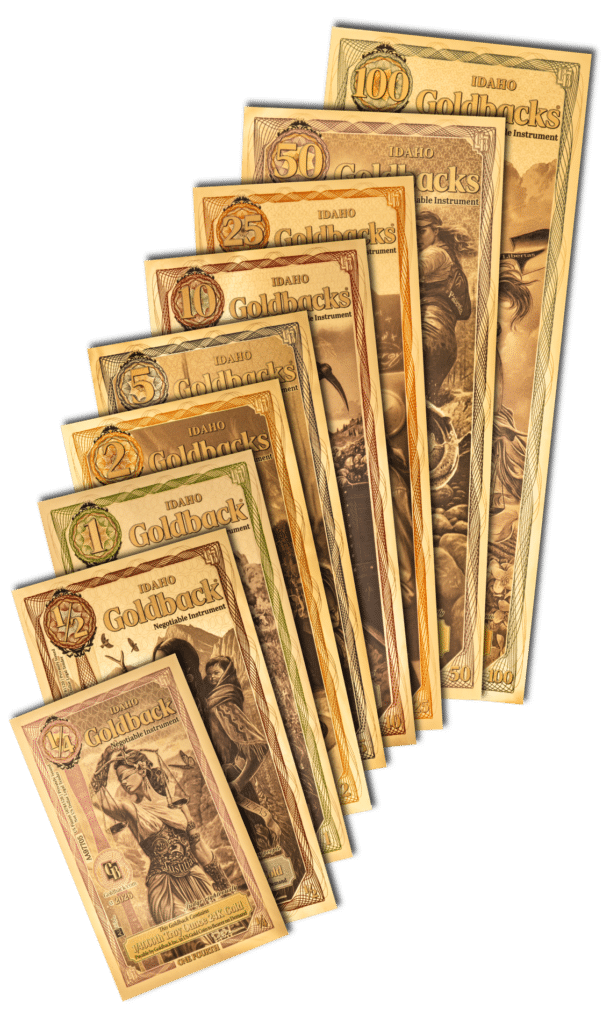
According to Goldback, each Goldback bonds 99.9% pure 24K gold between durable polymer layers using Valaurum’s 5th-generation vacuum-deposition technology. One Goldback equals 1/1,000 of a troy ounce of gold, and the 1/4 Goldback (1/4,000 oz) is, as the company describes it, the smallest physical gold currency denomination on the market. It comes in eight active denominations — 1/4, 1/2, 1, 2, 5, 10, 25, and 50. Goldback reports a network of 5,000+ participating merchants, strongest across nine live state series: Utah, Nevada, New Hampshire, Wyoming, South Dakota, Oklahoma, Florida, Arizona, and Idaho. (The 100 Goldback was discontinued, but existing 100s remain valid and usable at participating merchants.) Goldback, Inc. was launched in 2019 by founder and CEO Jeremy Cordon and incorporated in Utah.
| Feature | Goldback | PAX Gold | Tether Gold | Kinesis | Gold ETFs | Physical bullion |
|---|---|---|---|---|---|---|
| Form | Physical gold currency | Digital token | Digital token | Digital + card | Brokerage shares | Coins / bars |
| Hold the gold directly? | Yes | No (claim) | No (claim) | No (claim) | No (claim) | Yes |
| Counterparty risk? | None | Issuer | Issuer | Issuer | Custodian | None |
| Physically spendable in person? | Yes | No | No | Via card (converts to fiat) | No | No |
| Divisible for small payments? | Yes (to 1/4,000 oz) | Fractional, digital | Fractional, digital | Fractional, digital | No | No |
| Redeem / settle as | Already gold in hand | Physical bars or fiat | Physical gold or fiat | Physical gold or fiat | Cash from share sale | Cash near spot |
One point about Goldback is widely misunderstood: the premium. A Goldback trades at roughly a 100% premium over the spot value of its gold, which covers a complex manufacturing process, advanced multi-layer anti-counterfeiting technology (four layers: UV-reactive ink, serial numbers, crystallization patterns, and raised imagery), and the engineering required to turn gold into a durable, divisible currency. But unlike a coin or bar sold at melt value, a Goldback spent at a merchant returns its full currency value as purchasing power, and Goldback says its authorized distributors buy Goldbacks back at spreads tighter than melt, so converting to dollars need not forfeit the premium. The premium is the price of usability, and spending or exchanging the Goldback is how you recapture it.
Is Gold-Backed Currency Legal?
Owning and using gold-backed money is legal in the United States. Americans can freely buy, hold, and trade physical gold; private ownership was fully restored at the end of 1974, after the 1933 and 1934 restrictions were lifted. National currencies today are fiat and no longer redeemable for gold.
Privately issued gold currencies such as Goldback are legal to use voluntarily. Goldback operates as a voluntary, local-currency model running alongside the existing system, and isn’t government-backed. People choose to accept it because it is real gold, exchanged at a published daily rate, not because any law requires them to.
What Do People Mean When They Search for Gold-Backed Currency?
People searching for “gold-backed currency” are usually asking about one of a few related ideas: money tied to gold, gold you can own, or gold you can actually spend. Here is what the most common related phrases mean.
- Gold-backed currency — money whose value is tied to physical gold, either redeemable for gold or containing gold itself.
- Gold currency — currency made of or directly representing gold, from historical gold coins to a modern physical gold currency like Goldback.
- Gold-backed assets — any holding whose value is supported by gold, including bullion, gold ETFs, and gold-backed tokens such as PAX Gold and Tether Gold.
- Spendable gold — gold issued in small, practical denominations you can use for everyday purchases instead of only storing.
- Gold-backed payment system — a way to pay using gold-linked value, whether through a card that draws on vaulted gold (like Kinesis) or by physically handing over a gold currency (like Goldback).
These searches overlap because they circle the same underlying question: how to connect real gold to usable money. The answer spans stored gold (bullion, ETFs), claimed gold (stablecoins), and spendable gold (a physical gold currency).
Frequently Asked Questions
Is the U.S. dollar backed by gold?
No. The U.S. dollar has been a pure fiat currency since 1971, when the United States ended the dollar’s convertibility into gold. Its value now rests on the government and public confidence, not on metal held in reserve.
What is the gold standard?
The gold standard is a monetary system in which a currency’s value is fixed to a set amount of gold and can be redeemed for it. Major economies ran on it from the 1870s into the 20th century, and the last formal link ended in 1971. No country operates a full gold standard today.
What countries use gold-backed currencies?
No major nation currently runs a full gold standard; every national currency is fiat. The most prominent example of a government-issued, gold-backed currency is Zimbabwe Gold (ZiG), introduced in 2024 and backed by Zimbabwe’s gold and foreign-currency reserves. Most other gold-backed currencies today are private, such as PAX Gold, Tether Gold, Kinesis, and Goldback.
Is Zimbabwe Gold backed by real gold?
Partly. Zimbabwe Gold (ZiG) is backed by a reserve basket that includes the Reserve Bank of Zimbabwe’s gold holdings along with foreign currency, rather than by gold alone. It launched in April 2024 as legal tender within Zimbabwe and has faced ongoing stability and devaluation challenges since.
What is PAX Gold?
PAX Gold (PAXG) is a digital token issued by Paxos in which each token represents one fine troy ounce of London Good Delivery gold held in a professional vault. Holders can transfer it on the blockchain or, subject to thresholds, redeem it for physical gold. It is a way to own and trade gold digitally, not to spend gold in person.
What is Kinesis?
Kinesis is a digital monetary system whose gold unit (KAU) is backed by one gram of allocated physical gold stored in vaults. It pairs the token with a debit card, allowing holders to spend their balance, though a card purchase converts the gold to fiat at the point of sale rather than transferring gold itself.
Does gold protect against inflation?
Gold has historically held its purchasing power over long periods, which is why it is widely regarded as an inflation hedge. Because a gold-backed currency is tied to gold, a scarce asset that can’t be printed, it tends to resist the erosion that affects fiat money when the money supply grows faster than the economy. The protection plays out over years, not day to day.
Do central banks still hold gold?
Yes. Central banks hold large gold reserves and continue to buy. The World Gold Council reported that central banks added 1,045 metric tons of gold in 2024, the third consecutive year above 1,000 tons.
Are gold-backed stablecoins safe?
A gold-backed stablecoin is only as safe as the issuer and custodian holding the gold. Each token represents vaulted metal, but the holder owns a claim rather than the gold itself, which adds counterparty and custody risk that holding physical gold, such as a Goldback, does not.
How does Goldback work?
Each Goldback bonds 99.9% pure 24K gold between polymer layers, with one Goldback equal to 1/1,000 of a troy ounce. It comes in eight denominations across nine state series and can be spent in person at 5,000+ participating merchants, where its value is read from a daily exchange rate. You hold the physical gold directly, with no custodian or counterparty.
What is the difference between Goldback and gold bullion?
Gold bullion (coins and bars) is valued purely for its metal content, comes in large units, and is sold near spot price when you convert it to cash. Goldback is real gold issued in small, divisible denominations designed to be spent in person. Bullion is built to store gold efficiently; Goldback is built to spend it.
Conclusion
A gold-backed currency ties money to physical gold, either through redemption or by containing gold directly. That arrangement ran the world economy through the gold standard and the Bretton Woods era, then gave way to fiat money after the dollar’s gold convertibility ended in 1971. Gold never left the financial system, though. It remains a leading store of value and a reserve asset that central banks continue to buy by the thousand tons.
What has changed is the range of ways to hold gold-linked value: bullion and ETFs to store it, stablecoins like PAX Gold and Tether Gold to move it digitally, Zimbabwe Gold as a state’s attempt to anchor a currency to reserves, and Goldback as one of the few forms you can physically spend. The common thread is the idea that has drawn people to gold for centuries: value anchored to something real. What’s new is how many forms that idea now takes, and that, with the right one, you can hold gold and still spend it.
Related Articles
California and Utah Goldbacks Are Out Now! Here’s How to Get Them
Two major Goldback releases officially hit the market …

Goldback Celebrates National Policy Milestone: Three Sound Money Model Bills Clear Rigorous Multi-State Review
Goldback Inc. has achieved a milestone with the …

Preorder California and Utah Goldbacks Now!
Preorders for phase 1 of the California Goldback …

169 New Businesses Joined the Merchant Network in the Second Half of July!
The following businesses joined the Goldback Merchant Network …